Building OncoS2F: A Governed Agent for Genomic Foundation Models
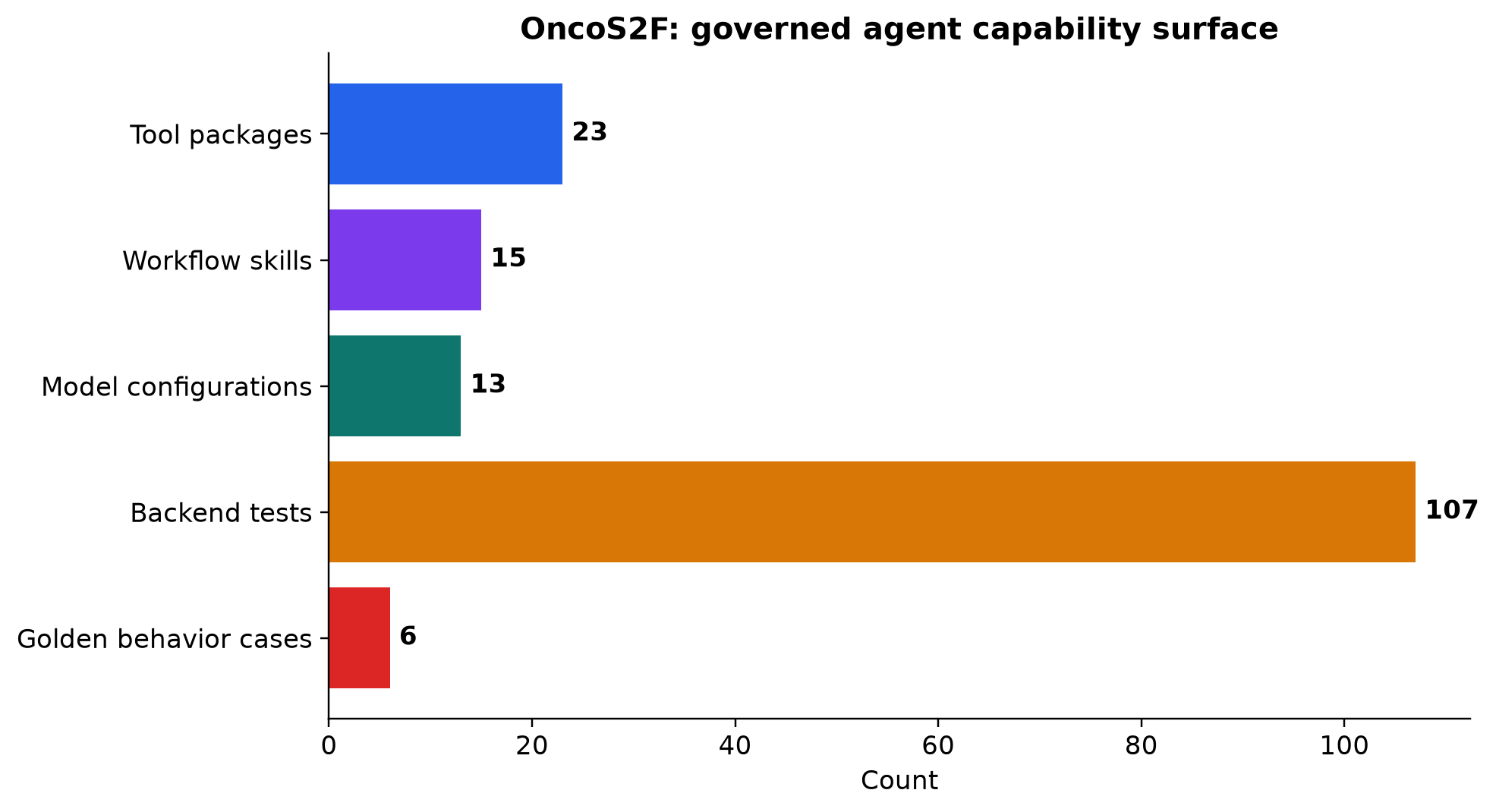
A full-stack biomedical AI agent that routes scientific requests across 13 genomic model configurations, 23 governed tool packages, and 15 workflow skills while enforcing plan approval, provenance, evidence separation, and research-use boundaries.
Disclosure note. Architecture, registry metadata, and aggregate test results are included. Session content, research data, prompts containing cohort information, credentials, endpoint names, account identifiers, and storage paths are excluded. OncoS2F is a research workbench, not a clinical decision system.
Building OncoS2F
Genomic foundation models can predict regulatory tracks, estimate sequence likelihood, generate embeddings, and compare reference and alternate alleles. Using them responsibly still requires much more than placing a chatbot in front of an API.
A scientist’s request must be translated into:
- a valid biological task;
- the correct model family and input representation;
- approved computation;
- inspectable outputs;
- source-labeled evidence;
- reproducible provenance;
- appropriately limited conclusions.
I built OncoS2F, a full-stack, research-use biomedical agent that orchestrates those steps. The current system exposes 13 genomic model configurations, 23 governed tool packages, and 15 workflow skills through a small language-model loop backed by deterministic policy and execution controls.
Table of contents
- The problem
- System architecture
- Agent loop
- Registry-driven model routing
- Tools and skills
- Governance and safety
- Evidence and provenance
- Evaluation
- Engineering impact
- Limitations
- Take-home
- References
The problem
A general-purpose agent can call tools, but biomedical work creates additional failure modes:
- routing a splicing question to a generic sequence-likelihood model;
- spending GPU resources before the user approves a plan;
- rerunning inference when saved results already exist;
- mixing model predictions with database annotations or literature evidence;
- losing the model version, input parameters, or artifact lineage;
- interpreting a research prediction as diagnostic or therapeutic evidence;
- loading patient or proprietary data into an unapproved execution context.
The design goal was therefore:
Keep flexible scientific reasoning in the model, but move permissions, routing contracts, execution boundaries, state, and verification into deterministic code.
System architecture
Scientist
   │
   ▼
React/Vite workbench
   chat • approvals • resources • jobs • tables • tracks • figures
   │  REST + server-sent events
   ▼
FastAPI agent API
   sessions • skills • models • jobs • reports
   │
   ▼
Agent control plane
   Bedrock tool-use loop
   canonical task state
   policy and plan gate
   bounded tool runtime
   verifier and traces
   │
   ├── Capability plane
   │     23 tool packages
   │     15 workflow skills
   │     13 model registry cards
   │
   └── Domain runtime
         sequence context • model adapters • references
         evidence connectors • viewers • analysis • reports
The language model is the orchestrator, not the system of record. Durable task state, approvals, jobs, reports, and provenance live outside the prompt.
Agent loop
OncoS2F uses two operating patterns.
ReAct for bounded, read-oriented work
For clarification, discovery, registry inspection, saved-result viewing, and reference lookup:
reason → select narrow tool → observe structured result → continue or answerPlan–Execute–Verify for consequential work
Compute, generated artifacts, external effects, and multi-step biomedical analysis require:
understand task
   → normalize inputs
   → propose explicit plan
   → wait for current approval
   → execute gated tools
   → verify outputs
   → label evidence and caveats
   → return artifacts and provenance
Approval is tied to the current plan. A previously approved session cannot silently authorize a new computation after resume.
Registry-driven model routing
Model behavior is not hard-coded into the main prompt. Each model card declares:
- supported task and input types;
- available outputs;
- variant classes and molecular modalities;
- context and parameter requirements;
- runtime and result adapters;
- model-specific workflow skill;
- limitations and unsupported use.
The registry currently represents nine genomic model families and 13 configurations, including five cell-specific chromatin models.
Routing follows declared capability:
requested task
  ∩ supported input
  ∩ required output
  ∩ variant class
  ∩ tissue/modality scope
  → eligible model set
If one model clearly matches, the router can select it. If regulatory, splicing, embedding, coding, or generative interpretations remain ambiguous, the agent asks a clarification question instead of choosing a universal fallback.
All model compute enters through one canonical tool. This keeps approval, staging, dry-run behavior, provenance, and error handling consistent across models.
Tools and skills
Tools are narrow capabilities
Tool packages describe:
- input/output schema;
- permission class;
- risk level;
- approval requirement;
- callable or viewer-only status;
- deterministic executor.
Examples include plan proposal, resource discovery, model selection, genomic-reference lookup, job monitoring, saved-score loading, approved analysis, and report generation.
Skills are bounded workflow knowledge
Skills contain scientific workflow guidance, references, deterministic scripts, and “do not use” boundaries for tasks such as:
- variant-effect prediction;
- attribution and embeddings;
- cross-model comparison;
- variant prioritization;
- genetic annotation;
- GWAS-to-function analysis;
- literature and trial synthesis;
- longitudinal disease analysis;
- result visualization and reporting.
Skill scripts cannot bypass policy. They execute only through an approved, gated tool.
This separation made the system extensible without turning the main prompt into an unreviewable collection of biomedical instructions.
Governance and safety
The execution rule can be summarized as:
allowed(tool, task) =
    declared_tool
  ∧ permitted_data_class
  ∧ within_read_or_compute_budget
  ∧ (not_gated ∨ current_plan_approved)
Key boundaries include:
- deny-first handling for unknown or side-effecting actions;
- research-use language by default;
- blocking patient/PHI data without an explicitly approved local policy;
- explicit review for proprietary cohorts and sensitive sequence-design work;
- path confinement for local resource reads;
- bounded skill and resource context;
- structured, JSON-safe tool failures;
- append-only trace events;
- post-tool verification before biological interpretation.
These controls live in code, so they hold whether or not the model complies with its prompt.
Evidence and provenance
OncoS2F keeps evidence layers separate:
raw model output
    ≠ derived score
    ≠ database annotation
    ≠ retrieved literature
    ≠ agent hypothesis
    ≠ clinical conclusion
Model jobs preserve:
- normalized input;
- selected model and version;
- task mode and parameters;
- job and artifact status;
- raw outputs before derived analysis;
- source identifiers for external evidence;
- generated tables, tracks, figures, and reports.
Saved-result viewers are deliberately separate from compute. Asking to display an existing score table or track profile should load the artifact—not rerun an expensive model.
Evaluation
I added deterministic tests around the behaviors the prompt depends on.
Backend verification
The current backend suite passes 107 of 107 tests. Coverage includes:
- plan and approval gates;
- stale-approval reset;
- tool registry and executor consistency;
- dynamic tool selection;
- resource path confinement;
- variant parsing;
- model routing and scope behavior;
- saved-result presentation without recompute;
- session ownership;
- upload and code-execution boundaries;
- deployment and pipeline-progress contracts.
Golden agent behavior
All 6 of 6 golden cases pass. These cases verify behaviors such as:
- model inference proposes a plan before compute;
- viewing saved results does not invoke model inference;
- model selection reads registry metadata;
- explicit embedding requests remain on the requested task;
- saved embedding analysis reuses existing artifacts.
Frontend verification
The React/Vite production build completed successfully, transforming 899 modules into a deployable bundle.
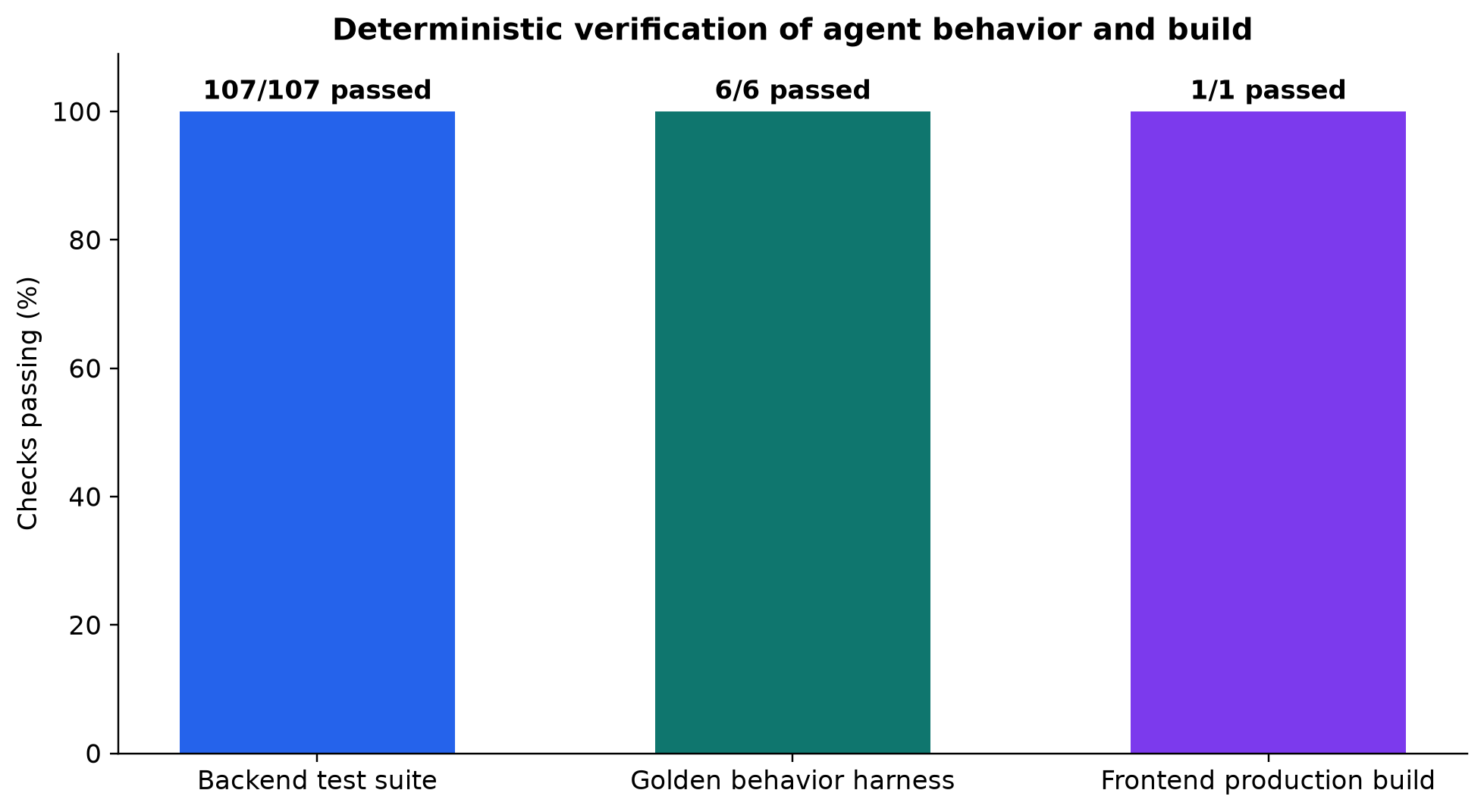
These tests do not prove scientific accuracy. They verify that the agent obeys its execution and routing contracts.
Engineering impact
OncoS2F turns multiple research components into a coherent platform:
- Natural language to valid model work. Scientists can describe a question without manually assembling every API payload.
- One governed compute boundary. New models reuse the same approval, staging, trace, and artifact contracts.
- Registry-based extensibility. Adding a model primarily requires a model card, adapter, skill, and tests—not rewriting the loop.
- Reproducible outputs. Scores, tracks, embeddings, figures, and reports remain linked to inputs and model versions.
- Visible scientific boundaries. Predictions and evidence remain labeled as research hypotheses.
The platform is especially useful when the challenge is no longer “can we run one model?” but “can we route, compare, inspect, and reproduce work across a changing model ecosystem?”
Limitations
- The golden behavior set contains six cases and should expand with adversarial and scientific-quality evaluations.
- Scientific model performance must be validated separately from agent control behavior.
- Local development metadata uses file-backed state; multi-worker production requires a transactional database.
- Production still needs stronger RBAC, organization-wide audit search, cost budgets, rate limits, and durable asynchronous job recovery.
- External biomedical connectors require source-specific authentication, pagination, citation, and error contracts.
- Patient, proprietary, clinical, and biosecurity-sensitive workflows remain blocked unless an approved deployment policy is configured.
- OncoS2F is not a diagnostic, treatment-selection, or regulatory-grade system.
Take-home
- I built a full-stack biomedical agent spanning a streaming workbench, tool-use control plane, model registry, workflow skills, and genomic compute runtime.
- The system routes across 13 model configurations, 23 tool packages, and 15 skills.
- Expensive or durable work requires a current, explicit plan approval.
- Raw predictions, derived results, external evidence, and hypotheses remain separate and traceable.
- 107 backend tests and 6 golden behavior cases pass, and the production frontend builds successfully.
- The central design principle is simple: let the model reason, but make the runtime own authority.
References
- Yao, S. et al. ReAct: Synergizing Reasoning and Acting in Language Models. ICLR (2023).
- Model Context Protocol. Core specification: tools, resources, and prompts.
- Amazon Web Services. Inference and tool use with the Amazon Bedrock Converse API.
- FastAPI. Server-Sent Events.
- Avsec, Ž. et al. Advancing regulatory variant effect prediction with AlphaGenome. Nature (2026).
- Brixi, G. et al. Genome modelling and design across all domains of life with Evo 2. Nature (2026).
- Jung, A. J. et al. Enigma: An efficient model for deciphering regulatory genomics. bioRxiv (2025).