Beyond Consequence Labels: Cohort-Scale Sequence-to-Function Interpretation
A dual-model workflow used AlphaGenome and Enigma to add functional evidence to variants missed by conventional high/moderate consequence labels, expanding the reviewable space while preserving clinical guardrails.
Disclosure note. All patient and sample identifiers, genomic coordinates, exact internal candidate variants, filenames, and cloud locations have been removed. Results are reported only as cohort-level aggregates. Candidate tiers are research-prioritization outputs, not clinical classifications.
Beyond Consequence Labels
Conventional variant annotation is excellent at answering questions such as “does this change a coding sequence?” It is much less direct at answering:
- Does a noncoding variant alter an enhancer or promoter?
- Does a synonymous change perturb splicing?
- Which tissue or molecular assay shows the strongest predicted effect?
- Do independent sequence-to-function models support the same mechanism?
I built a cohort-scale workflow that used AlphaGenome and Enigma as complementary evidence layers. Across 6,087 evaluated variants, AlphaGenome added functional signal to 2,554 variants outside conventional snpEff HIGH/MODERATE consequence labels—42% of the comparison cohort.
The correct claim is not “42% more actionable variants.” The correct claim is: the workflow expanded the reviewable space and added mechanism-oriented evidence.
Table of contents
- Goal
- Workflow
- Scoring methods
- Validation before scaling
- Cohort results
- Candidate prioritization
- Impact
- Limitations
- Take-home
- References
Goal
The goal was to turn a long variant list into a smaller, interpretable set of hypotheses without pretending model scores are experimental or clinical truth.
The workflow needed to:
- preserve the original annotation and review process;
- evaluate reference and alternate alleles consistently;
- combine evidence across RNA, splicing, chromatin, and regulatory modalities;
- validate scoring logic on known public examples;
- measure overlap between independent models;
- expose thresholds and uncertainty.
Workflow
Variant cohort
    │
    ├── Conventional annotation
    │      ├── HIGH / MODERATE
    │      └── LOW / noncoding
    │
    ├── AlphaGenome REF/ALT inference
    │      └── RNA • splice • chromatin • TF • contacts
    │
    ├── Enigma REF/ALT inference
    │      └── tissue-aware RNA • splice • ATAC • DNase
    │
    └── Evidence integration
           ├── model overlap
           ├── annotation-database review
           ├── mechanism-consistency checks
           └── research-priority tier
My contribution included data harmonization, batch inference, model-specific score normalization, validation panels, cross-model comparison, prioritization logic, and dashboards for review.
Scoring methods
Generic sequence-to-function delta
For model output f, a variant effect is:
Δ = f(xALT) − f(xREF)The sign gives direction and the magnitude gives predicted effect strength. The output must still be interpreted in the context of assay, tissue, and genomic location.
Enigma expression and chromatin scores
For a track window with pseudocount ε:
scoreQTL = log₂(Σ fALT + ε) − log₂(Σ fREF + ε)Enigma splicing score
For junction j and position p:
scoresQTL = max(j,p) |log₂((fALT[j,p] + ε) / (fREF[j,p] + ε))|Evidence union
Let A be variants with AlphaGenome signal outside the conventional high/moderate set, and E the corresponding Enigma set:
Reviewable sequence-to-function set: U = A ∪ E
Model-supported overlap:            O = A ∩ E
This set logic matters. Requiring both models increases specificity but discards complementary signals. Taking the union expands recall but requires stronger review controls.
Validation before scaling
Before interpreting the cohort, I tested whether the scoring and extraction code reproduced published mechanisms.
Public mechanism checks
- TAL1 boundary perturbation: the model predicted approximately 88% loss of CTCF signal and a 143% increase in cross-boundary contact, consistent with disruption of an insulated neighborhood. The absence of a downstream RNA increase was retained as a limitation, not hidden.
- Metabolic multi-omics panel: 7 of 7 expected directions were concordant across RNA and regulatory readouts.
- Splicing panel: 5 of 5 known examples were directionally concordant.
- Cross-model splicing: Enigma’s paper-defined sQTL score correlated with AlphaGenome splice-junction effects at Spearman ρ = 0.62 on splice variants.
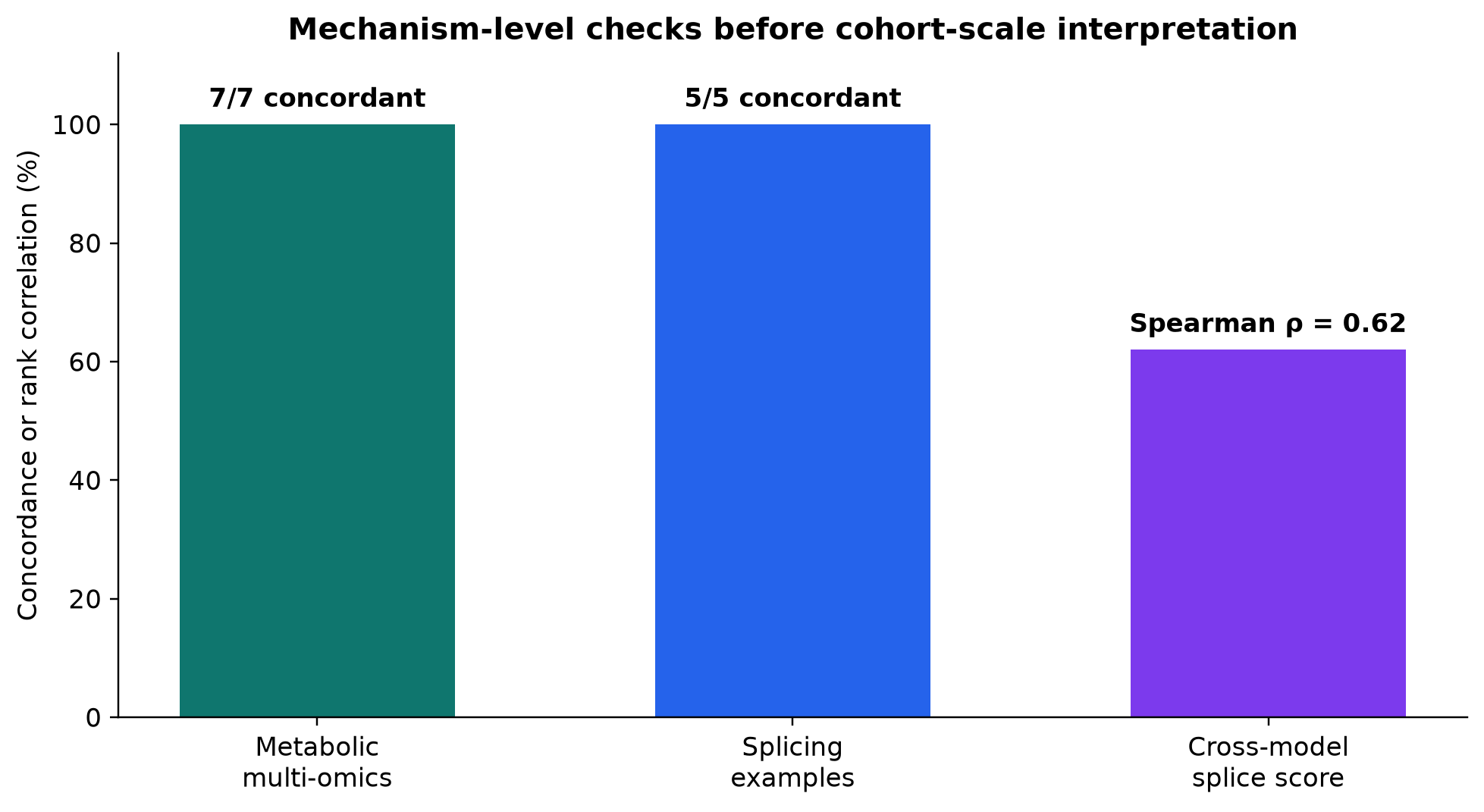
These are mechanism-level checks. Wet-lab assays remain the ground truth.
Cohort results
AlphaGenome expanded the reviewable space
Of 6,087 evaluated variants:
- 2,554 had AlphaGenome functional signal outside snpEff HIGH/MODERATE labels;
- this represented 42% of the comparison cohort;
- signals included enhancer, promoter, splice, transcription-factor, UTR, and synonymous contexts.
The models were complementary
Within the sequence-to-function-expanded set:
- 681 variants had AlphaGenome-only signal;
- 1,873 had signal from both AlphaGenome and Enigma;
- 271 had Enigma-only signal;
- the union contained 2,825 variants.
Enigma supported 73.3% of the AlphaGenome-expanded set.
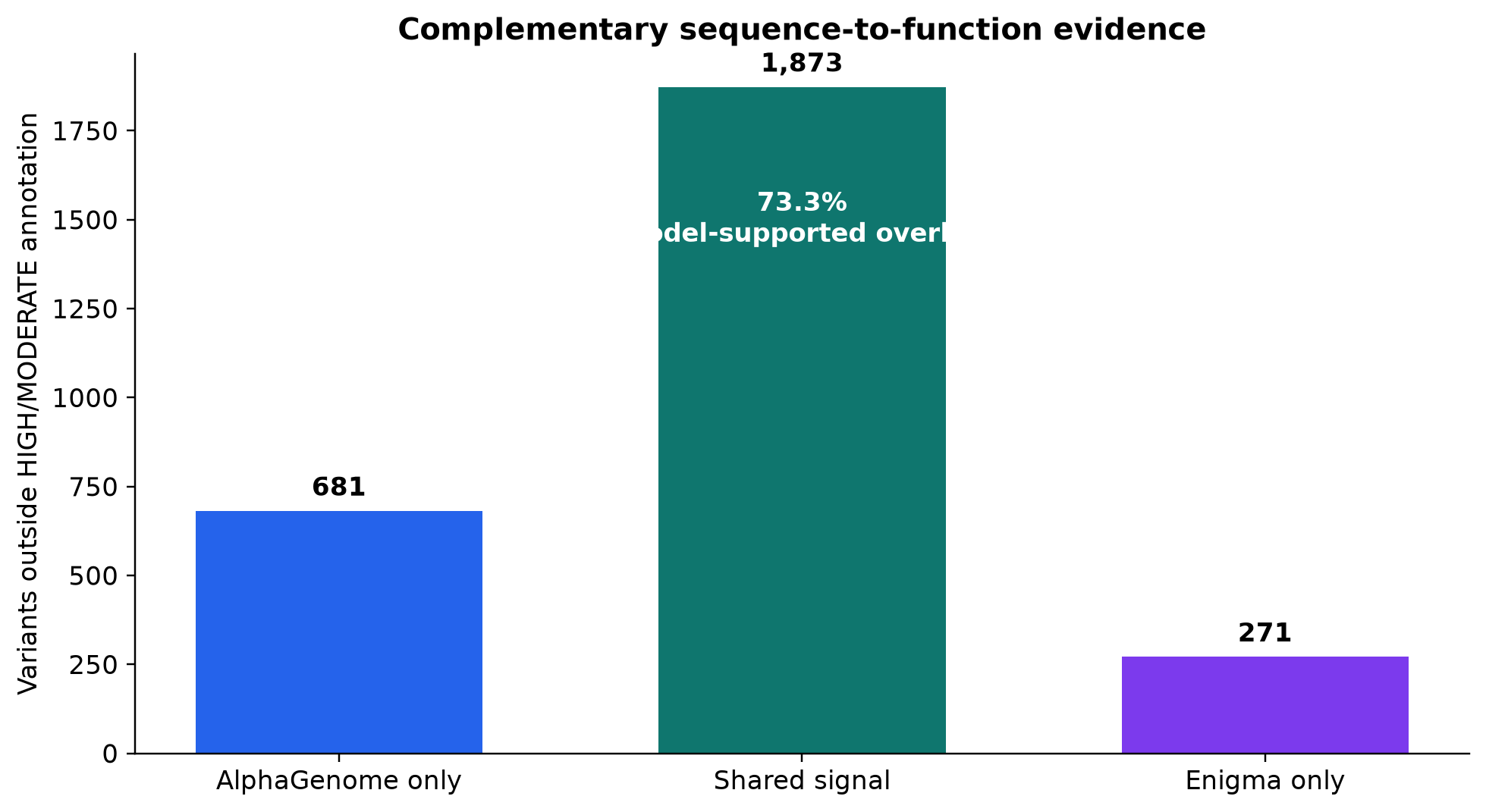
The shared set is useful for high-confidence review. The model-specific sets are equally informative: they show where different training data, tissues, tracks, or scoring functions create genuinely different evidence.
Candidate prioritization
A model score by itself is not a candidate tier. I combined:
- effect magnitude and direction;
- support from one or both models;
- match between predicted modality and local annotation;
- known cancer-gene context;
- absence or presence in existing annotation resources;
- reviewability of the proposed mechanism.
The aggregate prioritization produced:
- 122 high-confidence, annotation-database-negative research candidates;
- 56 top-tier candidates;
- 68 strong candidates;
- 676 mechanistically plausible candidates.
Exact variants and coordinates are intentionally omitted. These tiers prioritize research review; they do not establish pathogenicity, actionability, diagnosis, or treatment selection.
Impact
The project changed variant interpretation in three ways:
- From label to mechanism. Instead of a single categorical consequence, a variant could be reviewed in terms of a predicted splice, RNA, chromatin, or contact effect.
- From one model to evidence triangulation. Independent model agreement became a measurable confidence feature.
- From ad hoc review to a reproducible pipeline. Thresholds, modalities, model versions, and evidence provenance could be carried into a review dashboard.
The near-term product opportunity is an additive evidence layer:
Existing annotation + model-derived mechanism + database evidence + expert reviewIt should not silently replace existing annotations or autonomous clinical judgment.
Limitations
- The cohort analysis is retrospective.
- Functional predictions are not wet-lab validation.
- Thresholds influence both the overlap and the size of the reviewable set.
- Models share some training resources; agreement is not complete statistical independence.
- Sequence context alone cannot represent tumor purity, clonality, assay quality, or treatment response.
- Candidate enrichment does not estimate clinical utility without prospective review and outcome-linked validation.
Take-home
- Sequence-to-function models can surface functional hypotheses beyond coding consequence labels.
- AlphaGenome added signal to 42% of the evaluated cohort outside conventional high/moderate annotations.
- Enigma supported 73.3% of that expanded set and contributed additional model-specific signals.
- Public mechanism checks established that the pipeline extracted biologically coherent effects before it was scaled.
- The responsible output is a ranked, traceable evidence layer—not a list of newly “actionable” variants.
References
- Avsec, Ž. et al. Advancing regulatory variant effect prediction with AlphaGenome. Nature (2026).
- Ding, D. et al. Enigma: An efficient model for deciphering regulatory genomics (2025).
- Cingolani, P. et al. A program for annotating and predicting the effects of single nucleotide polymorphisms, SnpEff. Fly (2012).
- Hnisz, D. et al. Activation of proto-oncogenes by disruption of chromosome neighborhoods. Science (2016).
- Musunuru, K. et al. From noncoding variant to phenotype via SORT1 at the 1p13 cholesterol locus. Nature (2010).
- Luksan, O. et al. In silico, in vitro, and in vivo characterization of variants in the OTC gene (2020).
- Avsec, Ž. et al. Effective gene expression prediction from sequence by integrating long-range interactions. Nature Methods (2021).