Teaching Sequence-to-Function Models to Read Structural Variants
A structural-variant encoding study translated deletions, duplications, inversions, breakends, and gene fusions into matched REF/ALT DNA windows for AlphaGenome and Enigma.
Disclosure note. This post uses a public cancer-cell-line structural-variant truth set and public fusion examples. No patient-derived internal records, credentials, cloud resources, or proprietary sample identifiers are included.
Teaching Sequence-to-Function Models to Read Structural Variants
Sequence-to-function models naturally compare two fixed-length DNA windows. A structural variant (SV) is not naturally a fixed-length substitution: it may delete megabases, duplicate a segment, reverse an interval, or join two chromosomes.
The core research problem was therefore not simply “run the model on SVs.” It was:
How should each rearrangement be translated into biologically valid reference and alternate DNA sequences?
I designed an SV encoder, built matched AlphaGenome and Enigma inference workflows, and evaluated 77 public structural variants across five SV classes. The completed v2 release contains 107 encoded hypotheses in each model after a sequence-construction audit and targeted rerun.
Table of contents
- Problem
- Evaluation set
- Encoder design
- Model scoring
- Results
- What the audit changed
- Impact
- Limitations and next steps
- Take-home
- References
Problem
Small-variant inference usually replaces one allele inside a shared window:
REF window: ... A C G T [G] A T C ...
ALT window: ... A C G T [A] A T C ...
For an SV, the alternate sequence may have a different topology:
deletion:    left flank | right flank
duplication: left flank | copy | copy | right flank
inversion:   left flank | reverse-complement(interval) | right flank
breakend:    retained side A | retained side B
If the sequence construction is wrong, a precise model will return a precise answer to the wrong biological question.
Evaluation set
The working set contained:
- 65 non-insertion somatic SVs from the public COLO829 cancer-cell-line truth resource;
- 12 public, curated gene-fusion configurations;
- 77 modeled events in total.
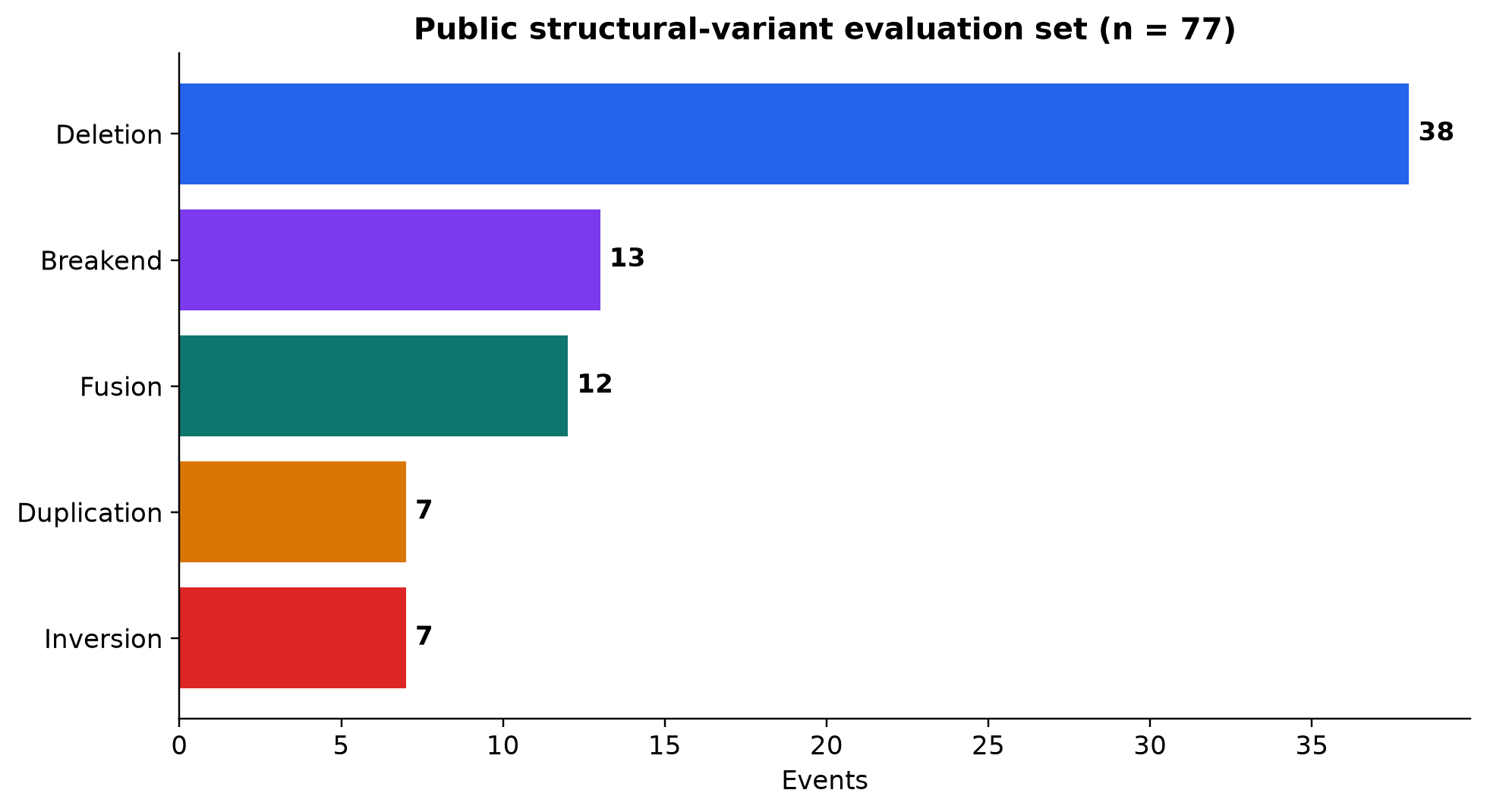
| SV class | Events |
|---|---|
| Deletion | 38 |
| Breakend/translocation | 13 |
| Fusion | 12 |
| Duplication | 7 |
| Inversion | 7 |
Insertions were not included because a valid alternate window requires the inserted bases, not only an SV type or length.
AlphaGenome used up to 1,048,576 bp of context; Enigma used 524,288 bp.
Encoder design
Deletion
For an event that fits in one window:
REF = left flank + deleted segment + right flank
ALT = left flank + shifted downstream sequence

REF: xxxxx dddd xxxxx
ALT: xxxxx      xxxxx
Long deletions use a breakpoint-junction fallback. They should not be truncated and presented as though the complete event fit inside the model context.
Tandem duplication
REF = left flank + one copy + right flank
ALT = left flank + copy + copy + right flank

REF: xxxxx [dup]      xxxxx
ALT: xxxxx [dup][dup] xxxxx
Reversing reference and alternate here would model copy loss, not duplication.
Inversion
REF = left flank + forward interval + right flank
ALT = left flank + reverse-complement(interval) + right flank

REF: xxxxx 1234 xxxxx
ALT: xxxxx 4321 xxxxx
Breakends and fusions
For a two-breakend event, both derivative hypotheses may matter:
REF1 = native window around breakend 1
REF2 = native window around breakend 2

ALT primary    = retained side 1 + retained side 2
ALT reciprocal = retained side 2 + retained side 1
The reciprocal product is a hypothesis, not a guarantee that the second derivative exists, is stable, or is expressed.
Regulatory hijack
When the direction of fusion biology is established:
REF = native target-gene context
ALT = 5′ regulatory context + 3′ target-gene body
This asks whether moving a target gene next to a different regulatory environment changes predicted molecular output.
A deliberate exclusion
I removed an earlier “expressed fusion junction” encoder. A spliced cDNA fusion is a transcript hypothesis, while AlphaGenome and Enigma consume genomic DNA. Mixing the two representations creates an invalid input even if the resulting sequence looks plausible.
Model scoring
Each encoder produced matched sequences:
Δm = summarym(fm(xALT) − fm(xREF))where:
mis AlphaGenome or Enigma;fmreturns RNA, splice, DNase, ATAC, or other tracks;summarymaggregates the relevant track around the event.
The comparison focused on:
- mean absolute RNA delta;
- effect direction;
- AlphaGenome–Enigma sign agreement;
- primary versus reciprocal derivative behavior;
- track-level profiles for mechanistic inspection.
Results
Fusion derivative junctions produced the largest RNA effects
| Encoder and event class | AlphaGenome mean |ΔRNA| | Enigma mean |ΔRNA| | n |
|---|---:|---:|---:|
| Primary derivative, fusion | 3.69 | 3.72 | 12 |
| Primary derivative, somatic breakend | 2.26 | 2.48 | 13 |
| Regulatory hijack, fusion | 1.34 | 1.37 | 5 |
| Local deletion/duplication | 0.67 | 0.68 | 45 |
| Local inversion | 0.26 | 0.24 | 7 |
The near-identical mean effects for primary fusion derivatives were encouraging because the models differ in implementation and training.
Direction agreement was strongest for high-effect hypotheses
- regulatory hijack: 100% sign agreement (
n = 5); - primary derivative: 96% (
n = 25); - reciprocal derivative: 80% (
n = 25).
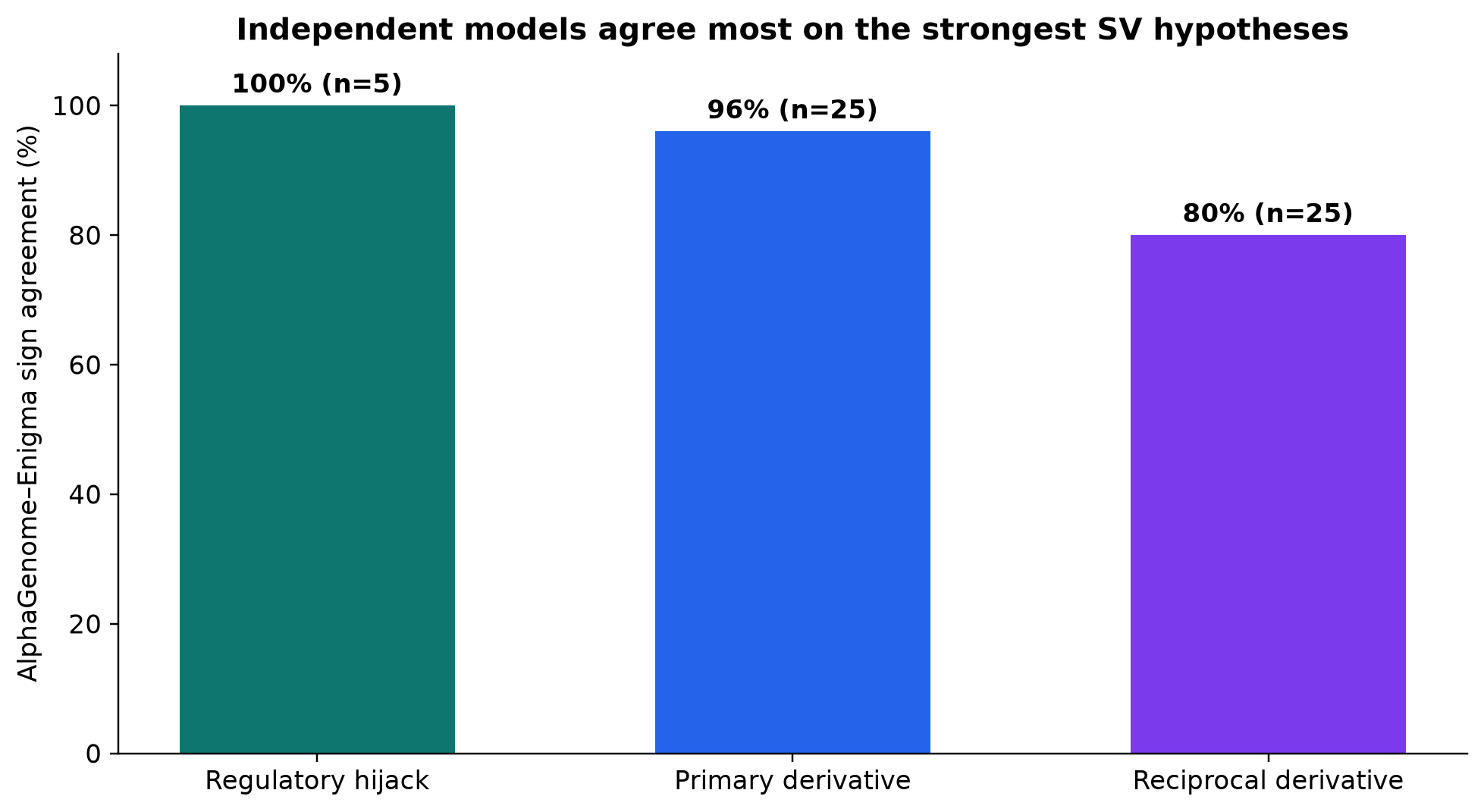
The lower reciprocal agreement is biologically plausible: which partner is centered changes local regulatory context, and the reciprocal product may be weaker or absent.
What the audit changed
During review, I found that local-event sequence construction needed stricter, type-specific definitions.
The v2 audit:
- encoded short deletions as complete deletions;
- encoded duplications as true tandem gains;
- centered complete inversions when they fit;
- retained breakpoint fallback for oversized events;
- removed transcript-like fusion inputs;
- identified 50 local-event windows for targeted rerun;
- reran all 50 corrected local events and merged them with the unaffected derivative hypotheses;
- produced a combined v2 release with 77 SVs and 107 runnable windows per model.
The correction preserved the strong derivative-junction findings and added valid local DEL/DUP/INV results. Recomputing questionable outputs is cheaper than building conclusions on an incorrect counterfactual.
Impact
The reusable contribution is the representation layer:
VCF/BND record
   → orientation-aware SV interpretation
   → model-specific fixed-length REF/ALT windows
   → multimodal track deltas
   → cross-model evidence package
That layer can support:
- fusion prioritization;
- regulatory-hijack hypotheses;
- splice and RNA-effect inspection;
- comparison of primary and reciprocal derivatives;
- benchmark construction for future SV-aware foundation models.
Limitations and next steps
- The derivative-junction set is small and enriched for strong public fusions.
- Sign agreement does not measure calibration or biological accuracy.
- Locus-matched negative junctions are still needed for AUROC and precision–recall analysis.
- Local DEL/DUP and inversion effects were weaker and reached approximately 71% sign agreement, so they require larger benchmarks before strong conclusions.
- Tissue mapping is approximate for some public examples.
- S2F models predict genomic regulatory consequences; they do not directly model transcript stability, nonsense-mediated decay, clonality, or treatment response.
- Future work should expand the fusion cohort and validate top hypotheses with expression or chromatin assays.
Take-home
- Structural-variant inference begins with a valid genomic counterfactual, not a model call.
- Type-specific encoders are required for deletions, duplications, inversions, breakends, and regulatory hijacks.
- AlphaGenome and Enigma showed 96% direction agreement on 25 primary derivative junctions.
- Fusion derivatives produced the strongest average RNA effects in both models.
- The encoder audit triggered a complete 50-window rerun and a merged v2 release.
The larger lesson is broadly applicable to AI for biology: representation choices define the scientific question before the neural network sees the data.
References
- Espejo Valle-Inclan, J. et al. A multi-platform reference for somatic structural variation detection. Cell Genomics (2022).
- Espejo Valle-Inclan, J. et al. COLO829 somatic structural-variant truth set. Zenodo.
- Avsec, Ž. et al. Advancing regulatory variant effect prediction with AlphaGenome. Nature (2026).
- Ding, D. et al. Enigma: An efficient model for deciphering regulatory genomics (2025).
- Mertens, F., Johansson, B., Fioretos, T. and Mitelman, F. The emerging complexity of gene fusions in cancer. Nature Reviews Cancer (2015).