When Sequence Is Not Enough: Modeling FFPE Artifact Risk
A group-held-out study across public multi-caller data and a de-identified matched FF/FFPE cohort showed that read-level technical evidence—not DNA sequence alone—is the key signal for FFPE artifact-risk modeling.
Disclosure note. Public SEQC2 data are the reproducible benchmark. Translation results from a matched FF/FFPE cohort are rounded and aggregate-only. Patient/sample identifiers, exact variants, sequencing-run identifiers, filenames, and storage or infrastructure details have been removed. Proxy labels are not molecular or clinical truth.
When Sequence Is Not Enough
Formalin-fixed, paraffin-embedded (FFPE) tissue makes archival tumor material available for genomic analysis, but fixation can damage DNA. Some damage survives variant calling and appears as a plausible somatic variant.
The tempting AI question is: “Can a large DNA model recognize the artifact from sequence context?”
Our experiments showed why that framing is incomplete. A real mutation and a fixation artifact at the same locus with the same reference and alternate alleles produce the same alternate DNA sequence. The information that separates them lives primarily in the reads: strand and orientation imbalance, base quality, read position, allele fraction, and caller evidence.
I built and evaluated an FFPE-risk modeling workflow across a public multi-caller benchmark and a de-identified matched fresh-frozen/FFPE cohort. The work produced a practical classifier, an operating-policy analysis, and an important negative result for frozen DNA foundation-model embeddings.
Table of contents
- Problem
- Label design
- Public benchmark
- Modeling approach
- Results
- Why the DNA foundation model did not help
- Operating policy
- Product impact
- Limitations
- Take-home
- References
Problem
FFPE artifact filtering is asymmetric:
- missing an artifact can create a false biological story;
- removing a real variant can erase clinically important evidence.
Accuracy at a default threshold is therefore not enough. A useful system must answer:
At a required retention of likely-real variants, what fraction of artifact-enriched calls can be flagged for review?
Label design
Public benchmark labels
The public anchor was the SEQC2 tumor-normal reference system, which provides deeply characterized somatic truth calls across assay and computational conditions.
Calls in high-confidence regions were labeled:
y = 0  if supported by the reference truth set
y = 1  if an FFPE call was not supported by the truth set
This is stronger than labels from unmatched clinical samples, but still has a noise floor near detection limits.
Matched-cohort proxy labels
For translation, matched fresh-frozen (FF) and FFPE samples from the same tumors enabled:
FF-concordant call → likely-real proxy
FFPE-only call      → artifact-enriched proxy
These are technical proxies. Tumor heterogeneity, sampling, coverage, and subclonality can make a real variant appear in only one preparation.
Public benchmark
I unified:
- 587 variant-call files;
- five callers;
- six assay conditions;
- three aligners;
- 54.9 million raw rows;
- 18.6 million labeled rows after removing uncertain labels.
Evaluation was group-held-out by physical sample token. No sample could contribute rows to both training and test sets.
This is essential: row-random splitting would let the model learn sample- or workflow-specific fingerprints and overstate generalization.
Modeling approach
Feature groups
The model used evidence available at or near variant calling:
- alternate and reference read counts;
- depth and variant allele fraction;
- caller confidence;
- strand or read-pair orientation imbalance;
- base and mapping quality;
- local substitution context;
- assay, caller, and aligner metadata when available.
Models
I compared:
- histogram gradient-boosted trees;
- random forests;
- a small sequence-context transformer fused with numeric features;
- frozen Evo2 likelihood and embeddings;
- published FFPE-filtering approaches where the available inputs allowed a meaningful comparison.
Evaluation
The primary metrics were:
ROC AUC  = ranking quality across thresholds
AUPRC    = precision–recall quality for the artifact class
F1       = harmonic mean of artifact precision and recall
Retention = TN / (TN + FP) for likely-real proxies
Results
Public multi-caller benchmark
| Model | F1 | ROC AUC | AUPRC | Likely-real retention |
|---|---|---|---|---|
| Full feature model | 0.852 | 0.959 | 0.920 | 0.943 |
| Caller-agnostic reduced model | 0.768 | 0.928 | 0.858 | 0.933 |
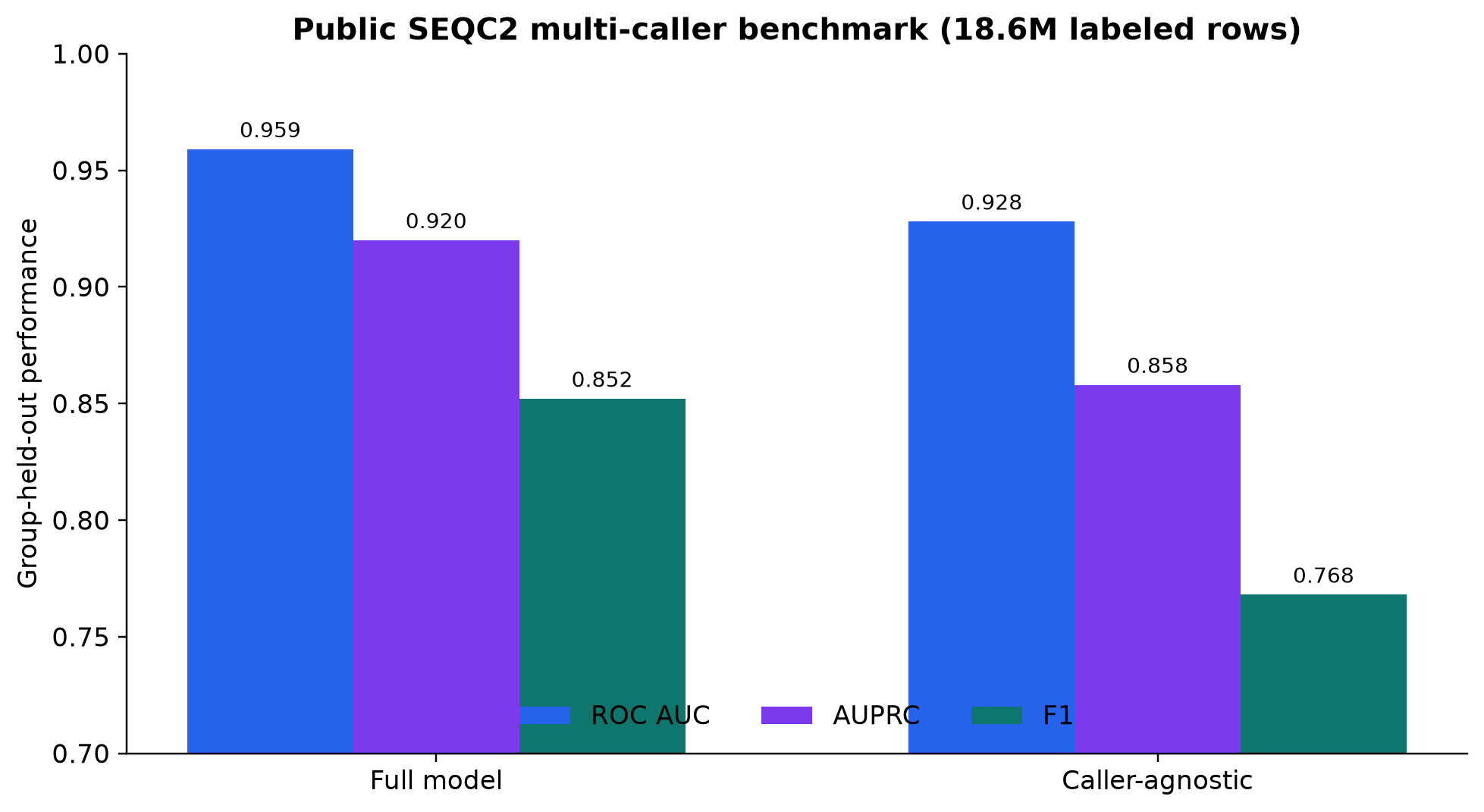
The performance drop in the reduced model quantifies a deployment trade-off. Caller metadata improves discrimination, but caller-agnostic features are easier to transfer across pipelines.
Mechanistic ablation
In a narrower public experiment, removing the dominant caller-confidence score reduced F1 by only about 0.003. The apparent importance of that field was largely redundant with mechanistic read-level evidence.
This was a useful model-review lesson:
High permutation importance does not prove a feature is load-bearing; correlated evidence must be removed and the model retrained.
De-identified matched-cohort translation
In the full, pre-filter aggregate of more than 85,000 calls, the tree ensemble reached ROC AUC 0.923, while the sequence-context transformer reached 0.919.
After current production-style filters, the remaining deployment population was approximately:
- 16,700 calls;
- 12,200 FF-concordant, likely-real proxies;
- 4,500 FFPE-only, artifact-enriched proxies.
The harder post-filter model reached leave-one-patient-out ROC AUC 0.790. This lower number is the more relevant deployment estimate: easy artifacts had already been removed upstream.
Why the DNA foundation model did not help
On a stratified pilot, frozen Evo2 features achieved:
| Feature set | ROC AUC |
|---|---|
| Mechanistic read/caller features | 0.810 |
| Evo2 delta embedding + likelihood | 0.493 |
| Evo2 plus mechanistic features | 0.776 |
Evo2 alone was indistinguishable from random ranking.
The reason is information-theoretic, not a failure of scale:
Hreal:      locus L, REF→ALT, observed from a true mutation
Hartifact:  locus L, REF→ALT, observed from fixation damage

Sequence input under both hypotheses = identical ALT sequence
A model receiving only the resulting reference/alternate sequence cannot infer how the observed base arose. Adding a larger context window or a more expressive embedding head does not restore evidence that was never present in the input.
Useful signals instead include:
P(artifact | reads, orientation, quality, VAF, caller, context)The negative result prevented further investment in a category-mismatched foundation-model approach and redirected effort to the evidence that can actually solve the problem.
Operating policy
A classifier becomes useful only when tied to a retention policy.
For a threshold τ:
Flag as FFPE-risk if P(artifact | evidence) ≥ τIn the post-filter matched cohort:
- at 90% likely-real retention, the model flagged 55.8% of artifact-enriched proxies;
- at 95% retention, it flagged 24.3%;
- at 99% retention, it flagged 3.3%.
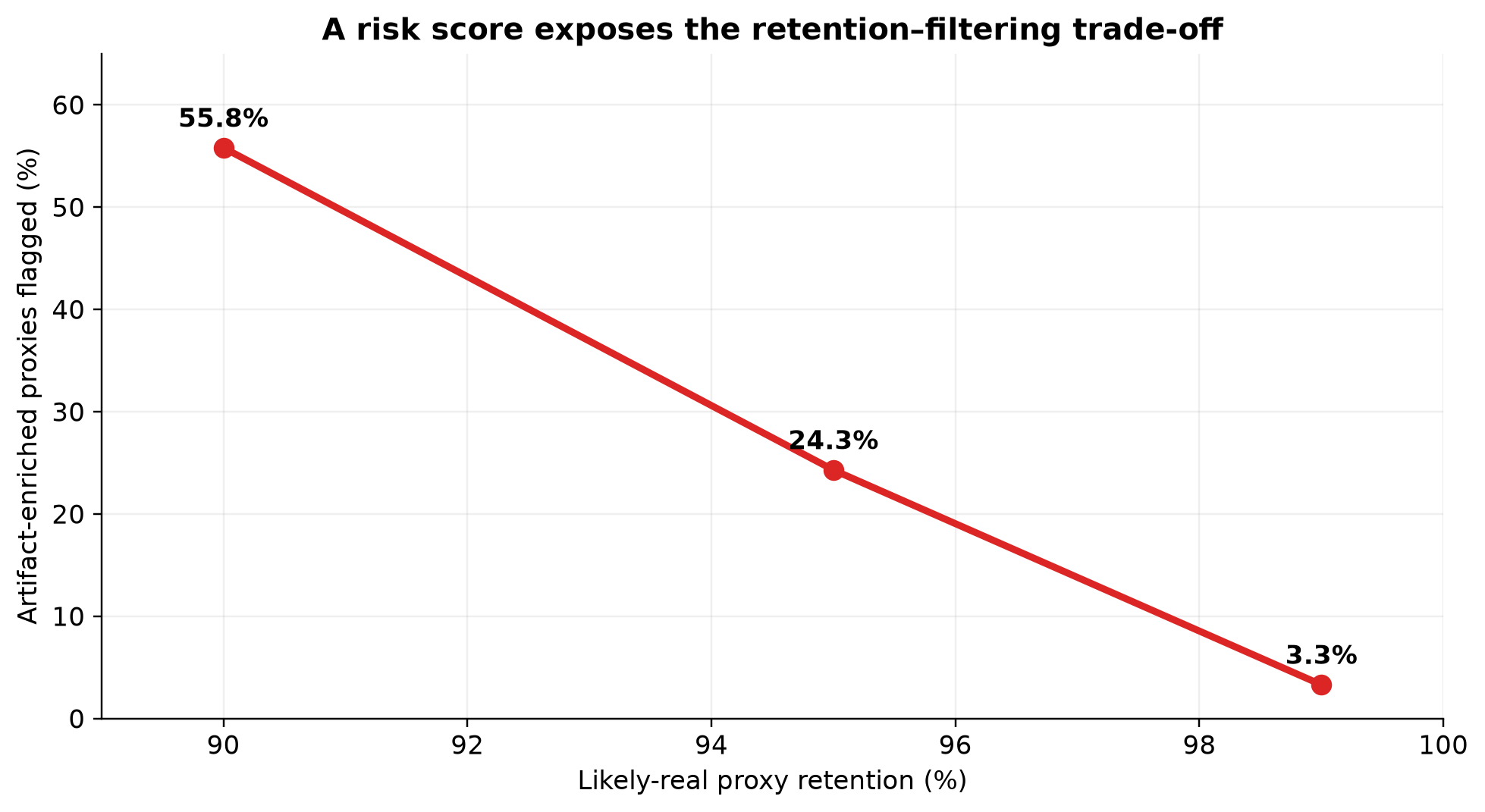
There is no universally correct threshold. A review-support tool may tolerate more flags than an automatic filter.
Product impact
The recommended deployment pattern is additive:
Variant caller
    → existing hard filters
    → calibrated FFPE-risk score
    → visible evidence and reason codes
    → expert review
The score should:
- annotate, never silently delete;
- expose its operating threshold;
- retain caller and assay provenance;
- report calibration drift by batch and workflow;
- preserve the original call and evidence;
- be prospectively validated before clinical use.
This creates a practical bridge between ML research and diagnostic-quality engineering: the model optimizes review effort while preserving human and pipeline controls.
Limitations
- FF-concordant and FFPE-only classes are proxy labels.
- The matched-cohort result is retrospective and rounded for publication safety.
- Performance varies by caller, assay, aligner, and filtering stage.
- Cross-caller transfer should not be assumed when feature definitions differ.
- Published comparator tools require different input evidence; VCF-only comparisons can be incomplete.
- The operating point requires prospective validation and clinical/QC governance.
- This system estimates technical artifact risk, not pathogenicity or actionability.
Take-home
- The public multi-caller model reached ROC AUC 0.959 and AUPRC 0.920 with group-held-out evaluation across 18.6 million labeled rows.
- The post-filter matched-cohort task was harder but operationally relevant: AUC 0.790.
- At 90% likely-real retention, the score flagged 55.8% of residual artifact-enriched proxies.
- A frozen genomic foundation model performed at chance because sequence alone does not contain variant-provenance evidence.
- The responsible product is a calibrated risk annotation with provenance and expert review—not an autonomous deletion rule.
References
- Fang, L. T. et al. Establishing community reference samples, data and call sets for benchmarking cancer mutation detection using whole-genome sequencing. Nature Biotechnology (2021).
- Sahraeian, S. M. E. et al. Achieving robust somatic mutation detection with deep learning models derived from reference data sets of a cancer sample. Genome Biology (2022).
- Heo, D. et al. DEEPOMICS FFPE identifies DNA-sequencing artifacts from FFPE tissue with deep learning. Scientific Reports (2024).
- Cebeci, E. et al. FFPolish: a machine-learning-based method for refining FFPE somatic variant calls. Frontiers in Genetics (2022).
- Frankell, A. M. et al. Enabling whole-genome sequencing analysis from FFPE specimens in clinical oncology. Nature Communications (2025).
- Brixi, G. et al. Genome modelling and design across all domains of life with Evo 2. Nature (2026).